
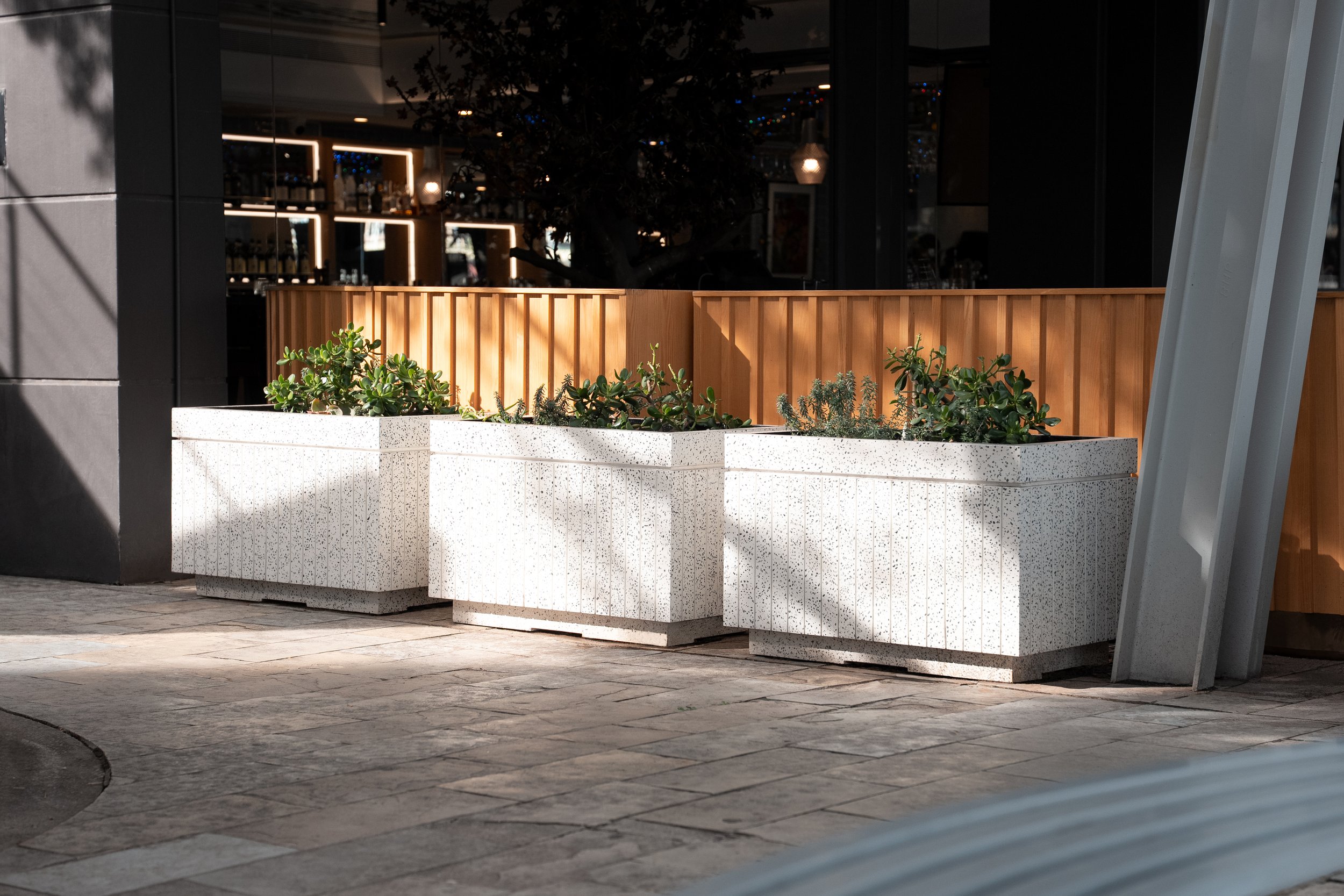
Glass Reinforced Concrete is often referred to in different ways such as GRC, Glass Fibre Reinforced Concrete or Lightweight Concrete. While the name can be interchangeable the fundamentals of well manufactured GRC remain the same and it is an amazing material for making high-quality precast concrete planters.
Key Benefits of GRC Concrete Planters
Due to its unique composition, GRC offers distinct physical and structural properties compared to traditional concrete. Here are the core advantages that make GRC planters a preferred choice for commercial projects.
Thinner & Lighter
Glass Fibre Reinforced Concrete (GRC) is essentially concrete but differs from traditional concrete through the addition of alkaline resistant glass fibres that provide significant additional flexural and tensile strength. Therefore, due to the amazing properties of GRC, the walls of GRC planters can be made significantly thinner than what is required for traditional cast concrete planters to achieve the same or greater strength. Often manufactured to a wall thickness of around 1.5 to 2 cm, GRC planters can be much lighter than precast concrete products. This is where the term lightweight concrete comes from.
Durable
The fantastic durability characteristics of concrete are well known and respected as evidenced by the extensive use of concrete in the construction industry over hundreds of years. This durability includes resistance to weather, water permeability, chemicals and fire. Glass fibre reinforced concrete does not readily burn or emit smoke when exposed to fire which makes GRC based pots and planters particularly suitable for high-rise buildings where fire performance requirements are critical.
Versatile
Glass fibre Reinforced Concrete (GRC) offers an unrivalled creativity and versatility in the development of new product designs because it can be used to accurately reproduce almost any small or large product design and can be finished in a wide variety of textures and colours.
Advantages of GRC Over Blockwork and Formwork
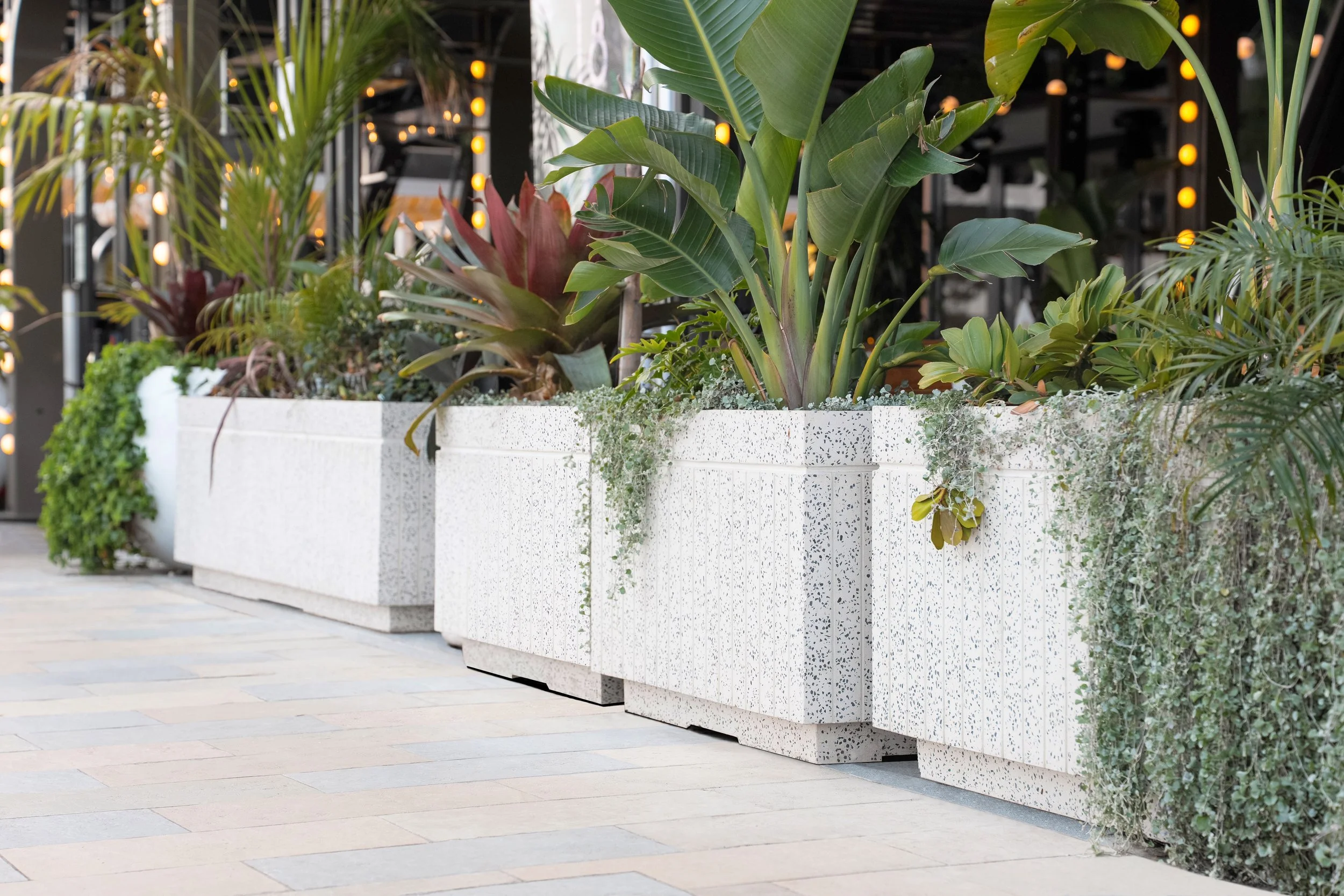
Project estimators, contract managers, and other professionals are often faced with the decision of choosing between GRC planters or some form of blockwork or formwork as part of the landscaping for their projects. Depending on the specifics of the project, each option may be appropriate. Below is a summary of the key benefits of choosing GRC planters over blockwork/formwork planter boxes.
GRC has Advantages Over Blockwork and Formwork
Project estimators, contract managers and project managers are often faced with a decision to choose between GRC planters or some form of blockwork or formwork as part of the landscaping for their projects. Depending on the circumstances of the project, each of these options may be appropriate. However, the following is a summary of some of the key benefits of choosing GRC planters over blockwork/formwork planter boxes.
Independence to Slab - Waterproofing
Precast GRC planters do not form part of the building slab and therefore will not develop hairline cracks over time due to movement in the slab. This is possibly the most important benefit of precast GRC planters over blockwork and formwork because hairline cracks facilitate water leakage. And the last thing you want to have to do is remove all the vegetation and planting medium from a large blockwork planter to find an elusive crack that is enabling water leakage.
Convenience & Flexibility
Since GRC planters are precast at a factory, they arrive at a landscaping site on a designated date ready to install. And this date can generally be changed if the project is either early or late. This flexibility can be very convenient when everyone is busy at the end of a project, and the pressure is on to complete.
Simplifying Project Management
Using prefabricated planters avoids the practical issues associate with scheduling and managing on-site tradesmen and the associate inconvenience of having their equipment and raw materials on site when there are all sorts of other tradesmen on site towards the end of a project.
Comparatively Lightweight
GRC planters are very strong due to the inclusion of glass fibre reinforcement. Therefore, the walls of the planters can be made much thinner than blockwork and formwork to achieve similar strength. This enables GRC planters to be much lighter and more suitable to balconies and other areas where weight is an issue.
Quality - Waterproofing
Manufacturing off-site allows for the use of optimum conditions for producing the highest quality concrete planters. On-site concrete mixing is less controllable and does not always provide optimum concrete strength and density which are important, in conjunction with appropriate internal membrane tanking, in avoiding water leakage.
Finishing Options
Satu Bumi’s Product Engineering Team can work to the individual design intent of just about any project in the design and finish of planters. This means the available options for shape, colour, texture, and size of planters is much greater than what can generally be achieved with on-site blockwork or formwork.
Consistent Planter Form
Professionally built moulds mean that each product will retain an identical form with a high degree of detail in the finish.
Modularity
Precast GRC planters are modular. Therefore, unlike blockwork and formwork, they can be moved if the landscape requirements change over time.
Designing intricate or non-standard architectural elements?
Discover how our precast formwork technology turns complex custom shapes into precise, scalable GRC solutions.